Morphological Analyzer
Computational LinguisticsNoor Morphological Analyzer
Importance of Morphological Analysis
One of the fundamental needs in text mining is morphological and derivational analysis of words, identifying word affixes, and extracting information such as word type, root, lemma (verb infinitive and singular of plural nouns), etc. This is used in most intelligent text mining activities including similarity detection, classification, and improving search engine results.
Structure of Noor Morphological Analyzer
Noor Morphological Analyzer consists of two main parts:
- Morphological Analysis Core using rule-based techniques
- Analysis Ranking System using machine learning techniques
Phase One: Rule-Based Analysis
In the first phase, processes such as:
- Identifying prefixes and suffixes
- Identifying root letters of the word
- Specialized analysis of Arabic linguistic rules (including I'lal (weak letter rules), Idgham (assimilation), Ibdal (substitution), etc.)
are performed. These processes utilize auxiliary linguistic databases (such as Arabic solid words bank, broken plurals, adjectives, etc.).
Finally, all possible analyses for a word are identified and presented along with more than 20 morphological features.
Phase Two: Machine Learning Scoring
In the second phase, after generating the set of possible morphological analyses for a word, using:
- Machine learning methods
- Neighboring word analysis
- Utilization of human-pre-validated corpora
the analyses are scored and ranked.
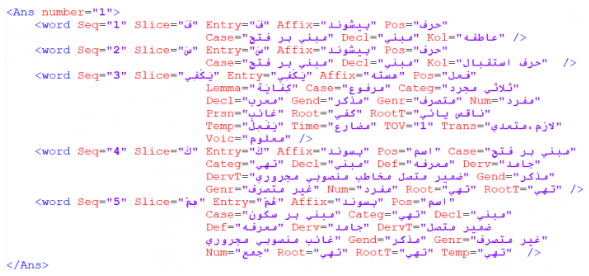
Important Applications
Identifying Cognate Words: One of the important applications of morphological analyzers is identifying words from the same family (cognates). In this regard, Noor Morphological Analyzer has been used to improve search engine results in Qamoos, Hadith, Noorlib, and other databases.
Quranic Morphological Corpus Production: This tool has also been used to produce a specialized morphological corpus for the Holy Quran.
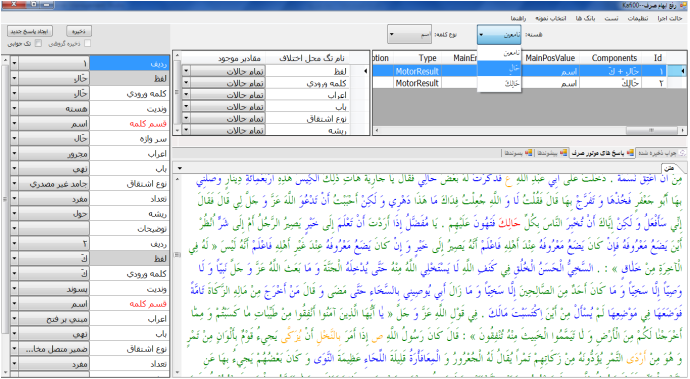
Applications
- Search Improvement: Enhancing search engine accuracy in specialized databases
- Text Similarity Detection: Identifying similar texts based on morphological structure
- Text Classification: Categorizing documents based on morphological features
- Quran Processing: Producing specialized morphological corpus for the Holy Quran
Benefits
- High accuracy combining rule-based and machine learning methods
- Extraction of more than 20 morphological features per word
- Support for complex Arabic language rules (I'lal, Idgham, Ibdal)
- Utilization of rich auxiliary linguistic databases