Event Extraction
Information ExtractionEvent Extraction
Importance and Significance of Event Extraction
Event extraction is one of the most important and challenging tasks in information extraction, serving as a foundation for many natural language processing applications such as:
- Semantic information search
- Text summarization
- And others
Definition of Event Extraction
Event extraction involves detecting and extracting important events such as:
- Death events
- Birth events
- Conflicts
- And other cases
from natural language texts.
Stages of Event Extraction
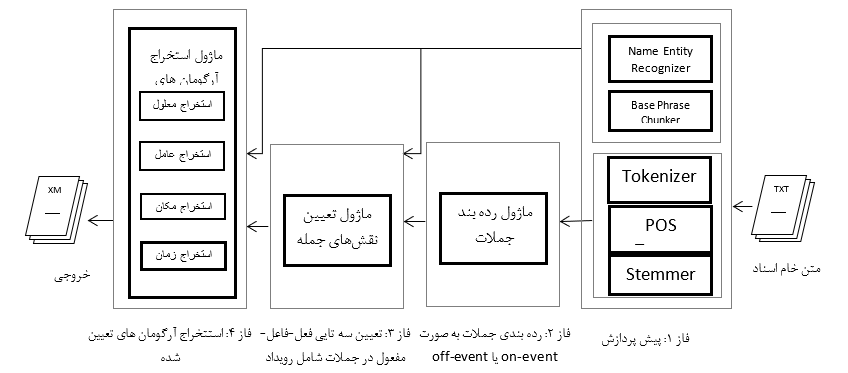
Event extraction consists of two main stages:
1. Event Type Detection (identifying sentences containing events)
2. Information/Argument Extraction (extracting participants and related information)
Special Feature of This Project
This project focuses on extracting events and related information from historical Arabic Islamic texts, which have a complex linguistic structure different from contemporary common texts. This can serve as a very useful tool for researchers in this field.
Methodology
Stage 1 - Event Type Detection
Correct detection of the event type and identification of sentences describing the event, as the first and most effective step, influences the accuracy of the event information extraction process.
Event Participants
Event participants can include:
- People or organizations
- Date
- Time
- Location
- Other information related to the event
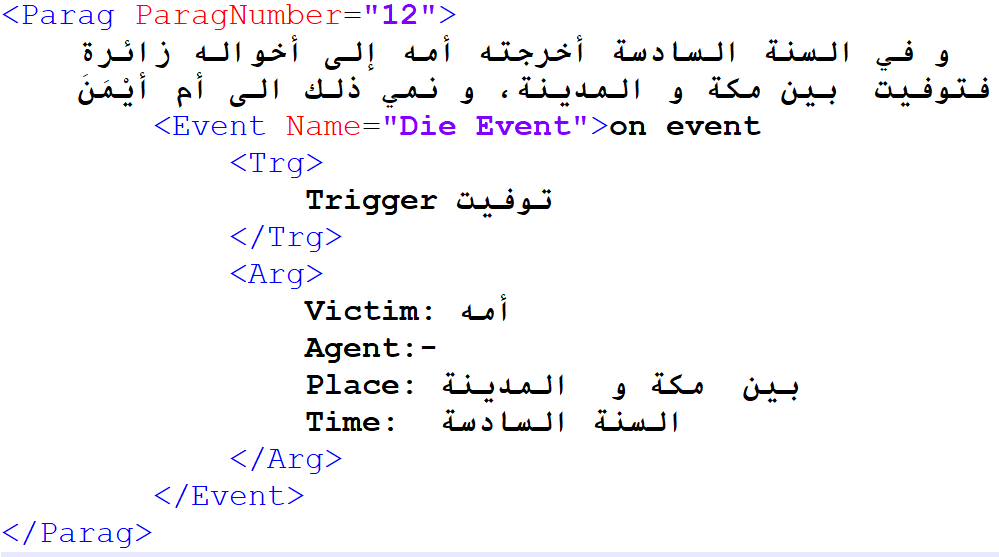
Example of Intelligent Detection of Specific Historical Events (e.g., Death Event)
Binary Classification Approach
In this system, the problem of determining event-containing sentences is treated as a binary text classification problem, assigning one of two classes to each text sample (sentence):
| Class | Description |
|---|---|
| On-Event | The sentence contains one or more instances of the target event type |
| Off-Event | The sentence contains no instances of the target event type |
Applications
- Historical Research: Automatic extraction of important events from historical Islamic texts
- Semantic Search: Finding events relevant to user queries
- Text Summarization: Generating event-based summaries
- Building Event-Centric Databases: Creating event-focused knowledge bases from Islamic texts
Future Research Directions
Future research directions include:
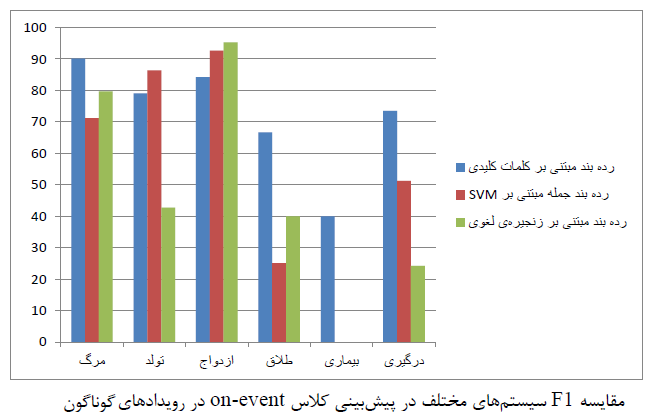
- Adding more features to observe their impact on the performance of the SVM-based classifier
- Proposing a method for automating the selection of influential features and their count
- Improving the lexical chain-based method by incorporating additional factors (such as time and word type) alongside the number of common words between the sentence and lexical chain
- Developing the system to generate extraction rules using rule generation systems with an initial rule set (reducing the need for a knowledge manager to create large rule sets)