Related Ayah
Recommender SystemsRelated Verses (Quranic Verse Association)
Concept and Necessity
Each verse of the Quran encompasses one or more concepts. Considering the context of revelation (Sha'n Nuzul) and the allegorical and metaphorical expression of the Quran, identifying and extracting these concepts must be done by experts and scholars of Quranic sciences.
Quranic exegeses (Tafseer) are valuable resources that contain the opinions of Quranic experts. Using the co-occurring verses method, one can find verses that have conceptual and semantic connections and are referenced by commentators.
Additionally, through the method of identifying relationships through shared topics between verses, verses that share common concepts can be identified.
Research Achievements
The results of this research show that intelligent processing can:
- Discover and extract connections that researchers have reached through extensive time and numerous studies in the Quranic field
- Extract new concepts and connections from the data
- Present them to experts as an intelligent Tafseer assistant (Mofassiryar) for further investigation
Case Study: The Verse of Wilayah (Guardianship)
In this program, the verse of Wilayah (regarding Imam Ali's (AS) charity while bowing) is examined, and 30 co-occurring verses are found.
Target Verse:
"Indeed, your guardian (Wali) is Allah, His Messenger, and those who believe who establish prayer and give Zakat while bowing." (Surah Al-Ma'idah, 5:55)
Top Co-occurring Verses
Based on analysis of 452 Persian and Arabic Tafseer books, the following verses have the highest co-occurrence frequency with the verse of Wilayah:
1. The Obedience Verse (Surah An-Nisa, 4:59)
"O you who believe! Obey Allah, obey the Messenger, and those in authority among you..."
109 co-occurrences in Tafseer texts
2. The Proclamation Verse (Surah Al-Ma'idah, 5:67)
"O Messenger! Proclaim what has been sent down to you from your Lord..."
71 co-occurrences in Tafseer texts
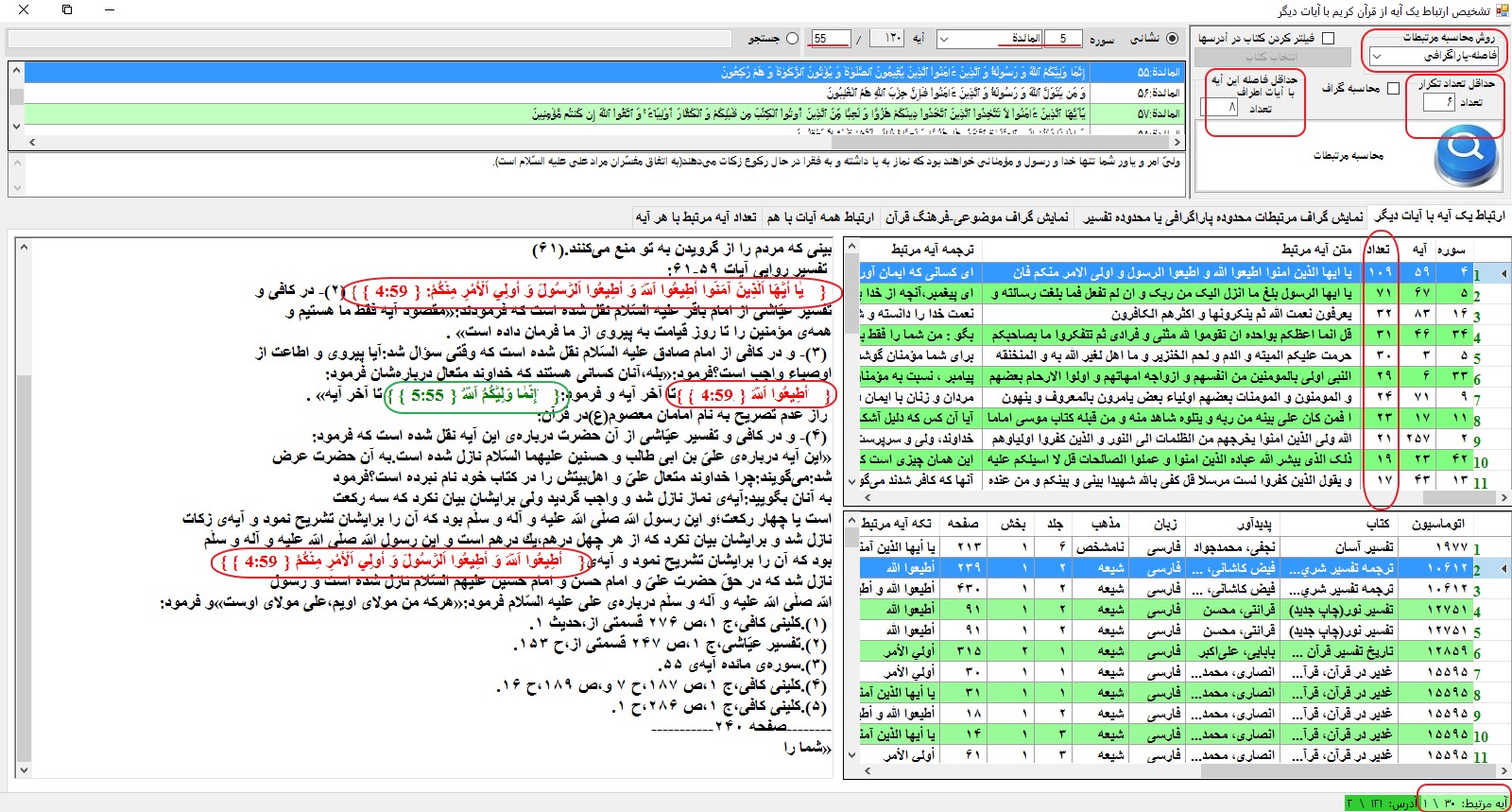
Graphical Visualization
To visually display the relationships between verses, facilitate easier use for researchers, determine next-level connections, and examine co-occurrence rules, the results are displayed as a multi-level graph.
Graph Structure:
- Central verse is placed at the center of the circle
- Related verses are placed on the first ring/circle
- Further co-occurrences continue on subsequent rings
Visual Features:
- Edges (lines) represent relationships between verses
- Line thickness is proportional to the connection strength/percentage (thicker line = stronger relationship)
Applications
- Tafseer Research: Discovering semantic relationships between verses based on authentic Tafseers
- Quranic Studies: Finding conceptually related verses to a target verse
- Intelligent Tafseer Assistant: Helping commentators identify co-occurring and related verses
- Quranic Network Analysis: Better understanding of the relational structure of Quranic concepts
- Quran Education: Presenting related verses for better concept understanding
Benefits
- Extracts semantic relationships based on analysis of 452 authentic Tafseer books
- Saves researchers' time (discovers connections in minimal time)
- Enables discovery of new and hidden relationships between verses
- Presents results graphically and interactively
- Supports both Persian and Arabic Tafseers